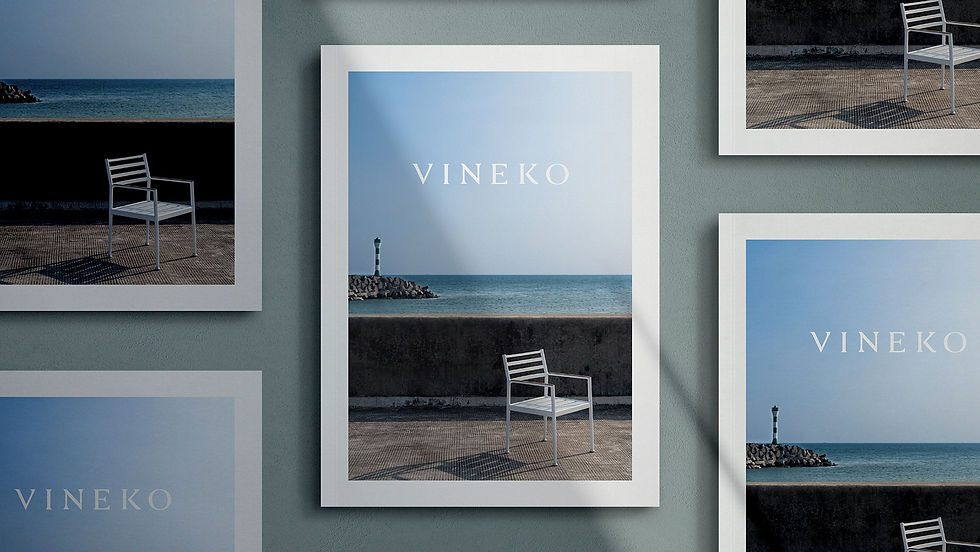
Giving craftsmanship a name of its own
- 1 day ago
- 2 min read

Designing VINEKO’s visual identity for its transition to the global stage.
Finding the meaning behind an unknown name
For years, VINEKO had been designing and manufacturing outdoor furniture for internationally recognised brands. Its products were already finding homes around the world, even if the company’s own name rarely travelled with them.
As confidence in its products continued to grow, so did its ambition. Rather than remaining behind the scenes as an OEM manufacturer, VINEKO wanted to establish itself as a modern outdoor furniture brand with roots in Greater China and a growing presence across East Asia.
The challenge was not to prove the quality of its work. That reputation already existed. The question was how to make the values behind that work visible under its own name.
Building a brand around an enduring belief
Conversations with the founder revealed that the brand had always been guided by a simple philosophy: 自我优化 — the constant pursuit of betterment.

It was more than a personal belief. It shaped how products were designed, how quality was judged and how the business had grown over time. Rather than introducing a new positioning, the project became an exercise in recognising a principle that had quietly guided the company from the beginning.
That understanding became the foundation of the identity.
Every element of the visual language was developed to express a brand that valued thoughtful craftsmanship, quiet confidence and continuous improvement over fleeting trends.

It also gave VINEKO a clearer way to express its ambition as a contemporary outdoor furniture brand, proudly designed and made in China, yet relevant to an international audience.
Instead of treating its Chinese roots and global ambition as opposing ideas, the identity brought them together through a shared belief in quality, care and enduring design.


Meaning travels further than origin
For organisations growing beyond the markets where they began, perception often becomes as important as capability.
People rarely experience the history behind a product. They experience the meaning a brand chooses to express.
When that meaning is rooted in genuine beliefs rather than carefully constructed claims, questions about where something comes from gradually give way to what it stands for. Identity cannot change a product’s origin, but it can help people recognise the values that have been there all along.